
We treat gambling as a risk-bearing activity, not a source of income. Spending controls, time limits and support routes should come before any decision to play, and this page explains all of them: what safer gambling means to us, how to set a budget, how to recognise warning signs, how to take a break, how self-exclusion works, where UK residents can find free help and what we do on our side to reduce harm.
Gambling at Kinghills is for adults aged 18 or over. If gambling has stopped being fun, or if any part of this page feels uncomfortably familiar, free and confidential support is available now from GamCare's National Gambling Helpline on 0808 8020 133, open 24 hours a day.
What Safer Gambling Means to Us
Safer gambling is not about telling adults how to spend their free time. It is about making sure that gambling stays a choice, made with clear information and within limits that are affordable. For us, that means four things.
- Honesty about the odds. Every casino game has a house edge. Over time, the expected result is a loss.
- Control tools from the start. Limits and breaks are offered before the first deposit, not hidden in settings.
- Watching for harm. We monitor accounts for signs of harm and act on what we see.
- Support when it is needed. Our team is trained to help, and we point to free specialist services.
How to Set a Spending Budget
A budget is the single most effective safer gambling tool, and it works best when it is decided before playing, not during.
Setting a Budget That Works
- Start with monthly income after essential costs such as rent, bills, food and debt repayments.
- Decide how much of what remains is for entertainment of all kinds.
- Choose a gambling amount within that, which could be lost entirely without causing worry.
- Treat that amount as spent, like the price of a concert ticket.
- Set a deposit limit in the account to match it.
Using Account Limits
| Limit | What it does | When it takes effect |
|---|---|---|
| Deposit limit | Caps deposits per day, week or month | Lower limits apply immediately |
| Loss limit | Caps net losses over a period | Lower limits apply immediately |
| Wager limit | Caps total stakes over a period, where available | Lower limits apply immediately |
| Session time limit | Ends the session after a set time, where available | Applies from the next session |
Any request to increase or lift a limit waits through a cooling-off period first. That delay is deliberate. Decisions to spend more are better made after a pause than in the middle of a session.
Budget Rules We Encourage
- Never gamble with money meant for bills, rent, food or debt.
- Never borrow to gamble.
- Never use gambling to try to solve a money problem.
- Withdraw winnings rather than playing them through.
- Stop when the budget is used, whatever has happened.
How to Recognise Risk Signs
Gambling harm often develops gradually, and the early signs can be easy to explain away. These are the signs that suggest gambling may be causing problems.
Signs in Behaviour
- Spending more money or time on gambling than intended.
- Chasing losses by depositing again or raising stakes.
- Feeling restless or irritable when not gambling.
- Gambling to escape worries, stress or low mood.
- Hiding gambling from family or friends, or lying about it.
- Borrowing money, selling possessions or missing bills because of gambling.
- Repeatedly trying to cut down without success.
- Neglecting work, study or relationships.
Signs in Thinking
- Believing a win is "due" after a losing run.
- Thinking a system or strategy will beat the odds.
- Seeing gambling as a way to make money.
- Feeling that only another win will make things right.
None of these signs alone proves a problem. But if several sound familiar, it is worth taking them seriously and talking to someone.
A Quick Self-Check
| Question | Yes or no |
|---|---|
| Has gambling cost more than could be afforded in the last few months? | |
| Has there been a need to gamble with larger amounts for the same excitement? | |
| Has there been a return to gambling to win back losses? | |
| Has money been borrowed or items sold to gamble? | |
| Has gambling caused stress, anxiety or arguments? |
Answering yes to any of these is a reason to consider limits, a break or a conversation with a support service.
How to Take a Break
Sometimes a short pause is enough to reset habits. A time-out blocks access to the account for a chosen period.
Taking a Time-Out
- Open the responsible gambling section of the account.
- Choose time-out.
- Select the length of the break from the options shown.
- Confirm.
Alternatively, ask our support team in live chat or by email. No explanation is needed.
What Happens During a Time-Out
- Login to play is blocked for the chosen period.
- Deposits and games are unavailable.
- Promotional messages stop.
- Cash balances can still be withdrawn with support's help.
- The time-out cannot be cancelled early.
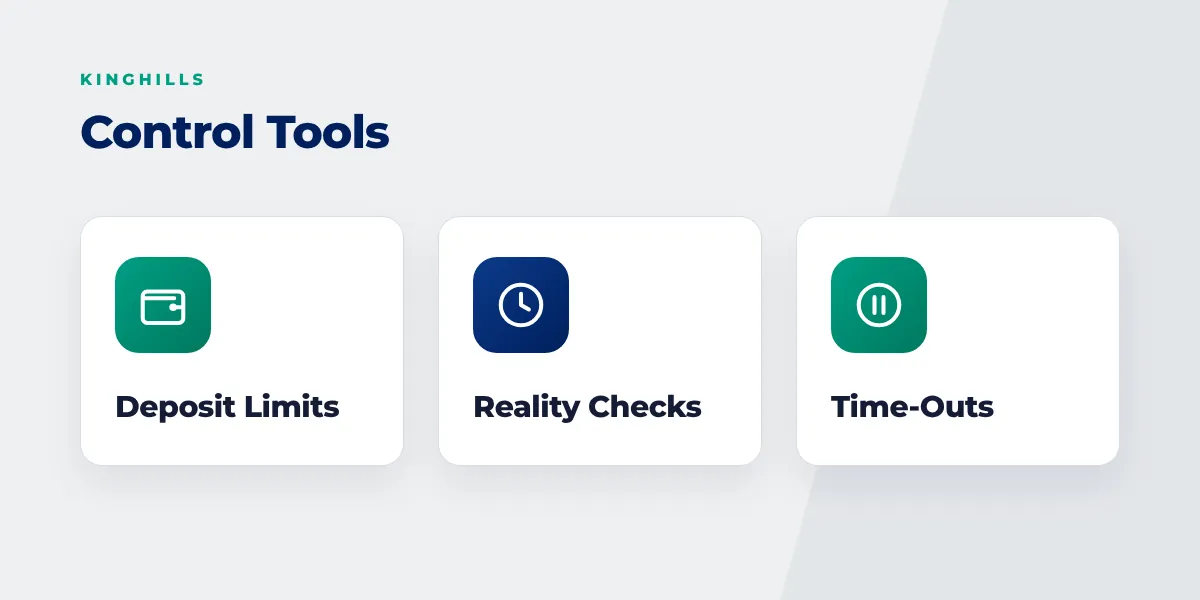
Deposit limits take less than a minute to set.
Set a limitHow Self-Exclusion Works
Self-exclusion is a longer and firmer break, designed for anyone who wants to stop gambling for a significant period.
Self-Excluding From Kinghills
- Open the responsible gambling section of the account, or contact support.
- Choose self-exclusion.
- Select the period from the options available, which run for months or years.
- Confirm.
What Self-Exclusion Means
| During self-exclusion | Detail |
|---|---|
| Account access | Closed for gambling for the full period |
| New accounts | We take steps to prevent new accounts being opened |
| Marketing | All promotional contact stops |
| Balances | Cash balances are returned to a verified method |
| Early reopening | Not possible |
| After the period ends | The account does not reopen automatically; a request and a cooling-off step are needed |
Self-Excluding From Many Sites at Once
GAMSTOP is a free UK service that lets people self-exclude from online gambling sites and apps in Great Britain in one step. Registration takes a few minutes, and exclusion periods range from months to years. Combining a Kinghills self-exclusion with GAMSTOP offers broader protection.
Blocking Tools
Extra layers of protection can make it much harder to gamble on impulse.
- Bank gambling blocks. Many UK banks let customers block gambling transactions in their app.
- Blocking software. Apps and browser tools can stop gambling sites from loading on phones and computers.
- Device screen time limits. Built-in phone tools can limit or block access to particular websites.
- Removing saved details. Deleting saved cards and passwords removes quick routes back.
Using several of these together is far more effective than relying on willpower alone. The best time to set them up is during a calm moment, well away from a gambling session, so they are already in place when an urge arrives.
Where Can UK Residents Find Help
Free, confidential support is available across the UK. Nobody needs to be in crisis to use these services.
| Service | What it offers |
|---|---|
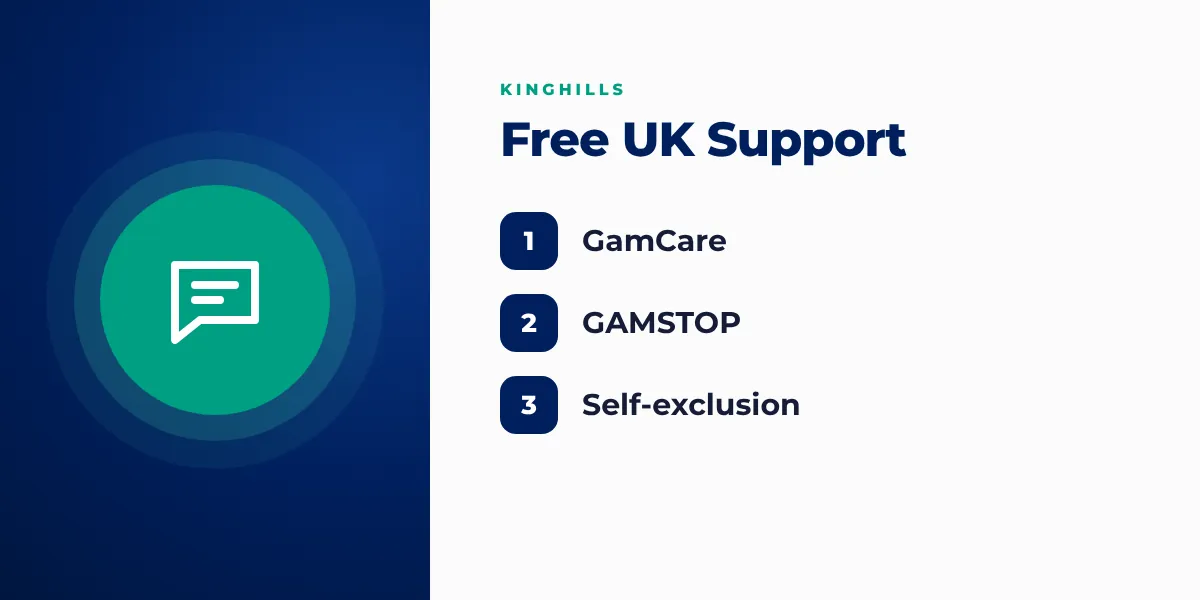
| GamCare | National Gambling Helpline on 0808 8020 133, live chat and treatment, 24 hours a day |
| GAMSTOP | Free self-exclusion from online gambling sites in Great Britain |
| BeGambleAware | Information, self-assessment tools and routes to treatment |
| Gamblers Anonymous UK | Peer support meetings across the country |
| NHS gambling clinics | Specialist treatment for gambling harm through the NHS |
For money worries linked to gambling, free debt advice services can help with budgeting and creditors. GamCare can also point to the right service.
Support for Families and Friends
Gambling harm affects the people around the gambler too. GamCare and other services offer support specifically for partners, family members and friends, including advice on how to talk about gambling and how to protect household finances.
What We Do on Our Side
Tools for members are only half of safer gambling. The other half is what we do.
Monitoring and Interaction
Our systems look for patterns linked to harm, such as rising deposits, frequent deposit attempts after losses, long late-night sessions and reversed withdrawals. When we see them, our trained team reaches out, offers limits or breaks, and in some cases applies restrictions.
Affordability Checks
We check whether spending appears affordable, particularly as deposit levels rise. Where necessary, we ask for information and set limits based on what we find.
Marketing Restrictions
- No promotions to accounts showing signs of harm.
- No promotions to members on a time-out or self-exclusion.
- No offers triggered by losses.
- Marketing that does not appeal to anyone under 18.
Staff Training
Our support, payments and account management teams are trained to recognise signs of harm and to have supportive conversations.
Age Verification
We verify that every account holder is 18 or over before real-money play.
Reality Checks and Session Reminders
Losing track of time is one of the most common ways a session runs over budget. Reality checks interrupt play at regular intervals with a short summary: how long the session has lasted and the net result so far. The member then chooses whether to continue or stop.
Setting a Reality Check
- Open the responsible gambling section of the account.
- Choose reality check or session reminder.
- Select the interval, for example every 30 or 60 minutes.
- Save the setting.
The reminder appears in every game, on every device. It is easy to dismiss, so it works best when paired with a decision made in advance, such as "when the second reminder appears, the session ends".
Time-outs and self-exclusion are in the account settings.
Manage limitsMyths That Keep People Gambling
Certain beliefs make it harder to stop. Recognising them is part of staying in control.
| Belief | Reality |
|---|---|
| A big win is due after a losing run | Every round is random and unaffected by past results |
| A system can beat the house | No staking system removes the house edge |
| Bonuses make gambling profitable | Bonuses extend play but do not change the odds |
| Losses can be won back with one good session | Chasing losses usually deepens them |
| Near misses mean a win is close | Near misses are just one of many random outcomes |
| Gambling is a reliable way to relax | It can become a source of stress when money is involved |
Talking About Gambling
Starting a conversation about gambling, whether about one's own play or someone else's, can feel daunting. A few approaches help.
- Choose a calm moment, not straight after a loss or an argument.
- Focus on feelings and effects, such as stress or money worries, rather than blame.
- Listen as much as talking.
- Suggest practical steps, such as setting limits together or calling a helpline.
- Remember that support services can help with the conversation too.
GamCare's advisers can talk through how to raise the subject, and their service is open to anyone affected, not only the person who gambles.
Gambling and Wellbeing
Gambling can affect sleep, mood, relationships and work. It can also be affected by them. Stress, loneliness, boredom and alcohol all make it harder to stick to limits. A few habits help:
- Avoid gambling when upset, tired or after drinking.
- Balance gambling with other activities and time with people.
- Take regular breaks during any session.
- Talk to someone if gambling starts to feel like the only way to relax.
Protecting Children
Gambling is for adults only. Members with children at home can help keep them safe by never leaving an account logged in, keeping passwords private, using parental controls on shared devices and not gambling in front of children where possible.
Coming Back After a Break
When a time-out or self-exclusion ends, returning should be a deliberate decision rather than an automatic one. Before playing again, it helps to set limits first, review what led to the break and consider whether support would still be useful.
Reality checks keep session time visible on every device.
Open settingsResponsible Gambling: Frequently Asked Questions
1. Can a Limit Be Removed Straight Away?
No. Lowering a limit is immediate, but raising or removing one requires a cooling-off period.
2. Can a Self-Exclusion Be Shortened?
No. Self-exclusion runs for the full period chosen.
3. Will Kinghills Contact Members During a Break?
Promotional contact stops. Essential account messages, such as those about returning a balance, may still be sent.
4. Can a Family Member Ask for a Self-Exclusion?
Self-exclusion has to be requested by the account holder. Family members can contact GamCare for advice and can share their concerns with our support team.
5. Does Asking for Help Affect an Account Negatively?
No. Asking for limits, a break or support is always respected, and it never counts against a member.
18+ only. If gambling is causing harm, call GamCare free on 0808 8020 133.